
How much should a plumbing company spend on marketing?
A real-numbers breakdown of plumber marketing budgets — cost per booked job, channel math, and three budget ranges by company size. The math most agencies hide.
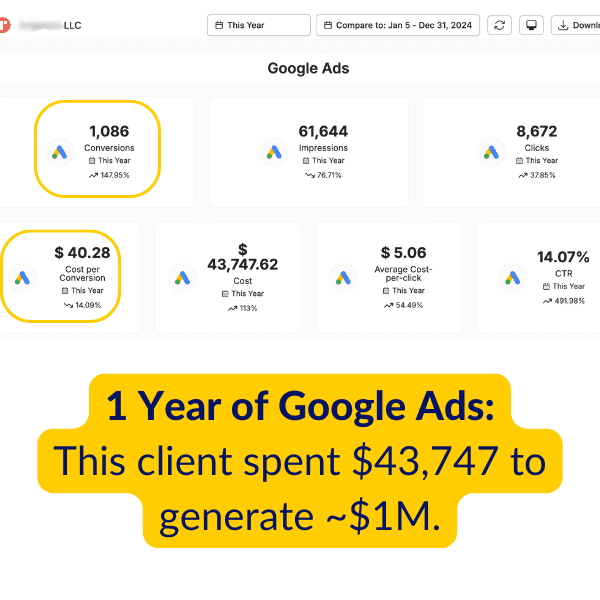
The honest answer is: it depends. But "it depends" is the worst answer in marketing, so let's actually break it down.
For a plumbing company, your marketing budget isn't a number you pull out of thin air. It's a function of three things: what you want to grow into, what your average ticket is, and what your current pipeline looks like.
The lazy benchmark — and why it's wrong
You'll read articles that say plumbers should spend "5–10% of revenue on marketing." That benchmark is mostly useless, for two reasons.
First, it doesn't account for where you are. A plumbing company doing $400K/year and a plumbing company doing $4M/year should not allocate the same percentage to marketing. The smaller company needs to spend a higher percentage to grow — they're under the awareness threshold in their service area, and percentage math assumes you've already built market presence.
Second, it doesn't account for what channels you're running. Spending $30K on a billboard and $30K on Google Ads are mathematically identical, but the conversion math is wildly different. Channel matters more than percent-of-revenue.
The real way to think about it
Forget percent of revenue. Think in terms of cost per booked job.
Pick a number — let's say your average plumbing job is worth $500 in revenue. At a healthy margin (say 35%), that's $175 in profit per job.
How much of that profit are you willing to spend to get that job? Most plumbing companies we work with land in the 15–25% range. Call it 20%. That means you're willing to pay $35 in marketing cost per booked job.
Now back into it: if your close rate on phone leads is 50%, you need 2 leads to book 1 job. So you can pay $17.50 per lead and break even on profit (or up to $35 per lead if you're scaling and accept thinner margin on growth).
Plug that into your channel:
- Google Ads in a typical suburban plumbing market: ~$45–$75 per lead. Tight margins, but real ROI when the funnel is dialed.
- Local Services Ads (Google Verified): $25–$80 per lead, pay-per-lead model. Often the cheapest qualified leads in the funnel.
- Facebook ads with a real offer: $25–$50 per lead. Lower intent, so close rate is lower — but volume is high.
- SEO: no per-lead cost once you rank. Just the monthly investment. That's why it compounds.
Three real budget ranges for plumbing companies
Here's how the math typically shakes out at three sizes:
One-truck operator just getting started
$1,500–$2,500 / month total marketing. Most of it should go into a working website and Google Business Profile optimization — the foundation. A small Google Ads test if cash flow allows. SEO begins to compound around month 6.
3–10 trucks, profitable, ready to scale
$3,000–$6,000 / month total. Now you can afford a real Google Ads campaign ($1,500–$3,000 in ad spend) on top of ongoing SEO and content. Facebook ads for filling the schedule. The system starts producing predictable lead flow within 60–90 days.
15+ trucks, dominating a market
$6,000–$15,000+ / month total. Multi-channel everything. Google Ads + Meta Ads + LSAs + SEO + a strong content engine. At this scale, you're not just buying leads — you're buying market share.
The number that actually matters
Whatever you spend, the only number that matters is: does the math work?
For every $1 you spend, are you getting back $3 to $7 in revenue? If yes, spend more. If no, the system isn't built right yet — and adding more budget will just light it on fire faster.
If you want to run your own numbers first, our plumber marketing ROI calculator does exactly this math. And if your real question is less "what should I spend" and more "what would it take to actually own my market," that's a different (bigger) number — we break it down in what it actually costs to dominate Google in your service area.
That's the conversation we have on every discovery call. We pull up the real CPCs in your market, your average ticket, your close rate, and we model what you should be able to produce. If the math doesn't work, we tell you. If it does, we tell you that, too. Full pricing is on the packages page.
Frequently asked questions
How much should a plumbing company spend on marketing?
Forget the lazy '5–10% of revenue' benchmark — think in cost per booked job instead. A one-truck operator typically needs $1,500–$2,500/month, a 3–10 truck company $3,000–$6,000/month, and a 15+ truck market leader $6,000–$15,000+/month. The right number is whatever produces $3–$7 back for every $1 spent.
What's a good cost per lead for a plumber?
It depends on the channel and your average ticket. Google Ads run ~$45–$75 per lead in a typical suburban market, Local Services Ads $25–$80, and Facebook $25–$50 at lower intent. Back into your max from profit: if a job nets $175 and you'll spend 20% to win it, you can pay roughly $17–$35 per lead at a 50% close rate.
Why is the percent-of-revenue marketing benchmark wrong for plumbers?
Because it ignores where you are and what channels you run. A $400K company needs a higher percentage than a $4M one — it's under the awareness threshold and percentage math assumes you've already built market presence. And $30K on a billboard vs. $30K on Google Ads is mathematically identical but produces wildly different results. Channel matters more than percent.
How do I know if my plumber marketing budget is actually working?
One number: for every $1 you spend, are you getting back $3 to $7 in revenue? If yes, spend more. If no, the system isn't built right — and adding budget just burns it faster. Track cost per booked job by channel, not vanity metrics like impressions or clicks.